Context7
Product status: Status not recorded
No lifecycle review is recorded for this listing. Its inclusion in the directory does not confirm current availability; check the vendor before relying on it.
No status check date recorded
Version-specific library documentation and code examples, served into AI coding tools so they stop inventing APIs. No lifecycle review is recorded for this listing. Its inclusion in the directory does not confirm current availability; check the vendor before relying on it.
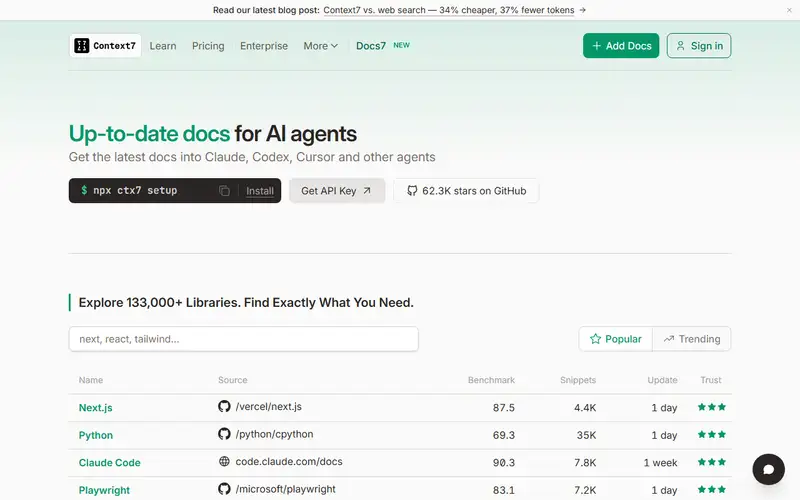
Product preview
Overview
Context7 supplies the documentation an AI coding tool needs at the moment it needs it: pages for a specific library at a specific version, plus code examples, delivered through MCP or an API into the editor rather than copied into a prompt by hand.
The problem it addresses is the one every model has: it learned the shape of a library at some point, and libraries change. Ask for an integration and you may get the API as it was two major versions ago, written confidently and wrong — which is worse than not knowing, because the failure arrives as plausible code. Retrieval fixes the source of truth but not the judgement: documentation describes intent, and the version-match is only as good as the indexing behind it, so the habit worth keeping is to check the version Context7 returned against the one in your lockfile before trusting the snippet.
Sources
The factual claims in this review were read from the pages below. Each date is when an editor last opened the source, not when the product changed.
- Vendor site Checked 2026-09-19
- Vendor documentation Checked 2026-09-19
Pros / Cons
Pros
- Attacks the actual failure — confidently wrong APIs from stale training data
- Version-specific rather than one frozen snapshot per library
- Reaches the editor through MCP rather than requiring prompt pasting
Cons
- Version accuracy depends on the indexing behind it and was not verified here
- Coverage is uneven: the popular libraries are well served, the long tail less so
- Documentation describes intent, so correct-looking code can still be the wrong approach
Who it's for
Coding agents that must use a current API
Reducing hallucinated method names in generated code
Giving an editor project-specific library context
Onboarding onto an unfamiliar library quickly
Bottom line
Feeds coding agents the current API instead of the one they memorised — useful precisely because libraries change under the model's feet.
Key Features
Tags
Frequently asked questions
Is Context7 currently available?
No lifecycle review is recorded for this listing. Its inclusion in the directory does not confirm current availability; check the vendor before relying on it.
What is Context7?
Context7 is a Agents & Developer Tooling tool developed by Upstash. Version-specific library documentation and code examples, served into AI coding tools so they stop inventing APIs.
Is Context7 free?
Context7 uses a freemium model: a free tier is available, and paid plans unlock more usage and advanced features.
Is Context7 open source?
Yes — Context7 is open source. The source code is publicly available at https://github.com/upstash/context7.
What are the best alternatives to Context7?
Notable Agents & Developer Tooling alternatives include Firecrawl, Browser Use, Daytona. Browse all 33 tools in our Agents & Developer Tooling category for a full overview.
Was this listing useful?
Basic Info
- Pricing
- Freemium
- Editorial score
- ★ 4.3 / 5 How we score
- Platforms
- APIWebMCP
- Last verified
- Not recorded