
Gorilla
Product status: Status not recorded
No lifecycle review is recorded for this listing. Its inclusion in the directory does not confirm current availability; check the vendor before relying on it.
No status check date recorded
Gorilla publishes function-calling research, model releases and BFCL evaluation; code, specific model rights and benchmark scope must be assessed separately. No lifecycle review is recorded for this listing. Its inclusion in the directory does not confirm current availability; check the vendor before relying on it.
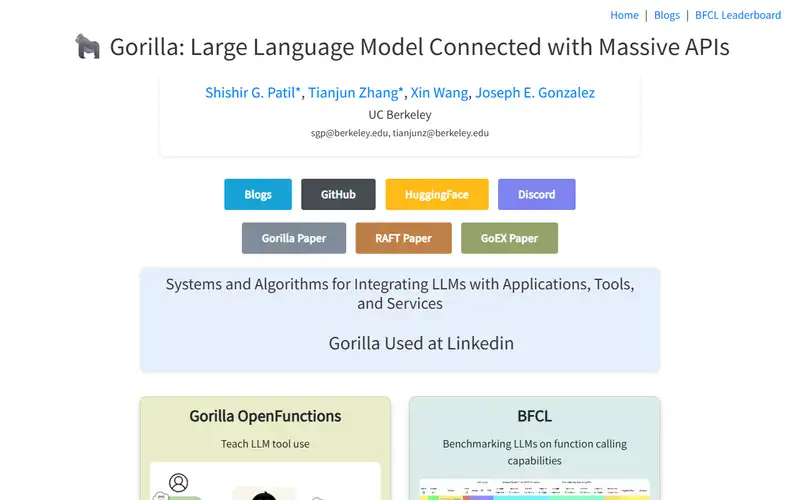
Product preview
Decision notes
Official-document research
Based on the cited documentation. We did not use the product, purchase a plan, or run quality, speed or reliability tests in this review.
Consider it for
- Researchers and developers able to validate model outputs and track artifact-specific terms
Choose another approach if
- Unreviewed production tool execution
- Assuming every Gorilla weight or dataset is unconditionally Apache2
Pricing and conditions
Documented terms
Repository code has no royalty under Apache2, but GPU, storage, hosting, API access and model-specific compliance costs are separate. A legacy no-key hosted example was not tested and does not establish a current free service. No current universal hosted price, quota, currency or tax was confirmed.
Pricing source read:
Pricing or terms sourceCode, model and service licensing
Apache2 covers repository code with license/notice/change obligations, not all data or weights. The official OpenFunctions v2 card adds DeepSeek Appendix A restrictions beyond its Apache2 tag. Its linked pinned model license includes use restrictions, derivatives/distillation and hosted-distribution duties to pass terms/notices onward; the data itself is not licensed. This is not unrestricted Apache-only model use or a statement about all current DeepSeek models. No output ownership claim does not clear inputs, data or generated outputs; provider training/retention remains unconfirmed.
Basis and limits of the recorded score
Original 4.4/5 retained; the original scoring worksheet and hands-on evidence are unavailable. This documentation review did not re-score it.
Overview
Gorilla is a research project covering function-calling models, API-oriented data and the Berkeley Function Calling Leaderboard. OpenFunctions documents v2 multiple and parallel calls and relevance detection. A model-generated function name or argument is not an authorized execution, and invalid JSON can fall back to a string; applications still need schema validation, permission checks and controlled execution.
BFCL's displayed overall score averages defined categories and estimates costs for a dated evaluation snapshot. The page was updated April 12, 2026 and links a fixed reproducibility version. It does not certify real-task safety, every current model or success on your APIs. No benchmark, model download or endpoint was run.
Sources
The factual claims in this review were read from the pages below. Each date is when an editor last opened the source, not when the product changed.
- Vendor documentation Checked 2026-10-15
- Vendor documentation Checked 2026-10-15
- Vendor documentation Checked 2026-10-15
- Vendor documentation Checked 2026-10-15
- Vendor documentation Checked 2026-10-15
- Vendor documentation Checked 2026-10-15
Pros / Cons
Pros
- Public research artifacts and evaluation definitions
- Specific model and code licenses can be inspected
Cons
- Function output needs validation and authorization
- Benchmark scores do not prove deployment safety
- OpenFunctions v2 has extra model-use restrictions
Who it's for
Researching function-call evaluation and schema validation
Assessing a specifically licensed model for controlled tools
Bottom line
Select a specific artifact and license, then validate it against your API and execution controls; neither an Apache tag nor a leaderboard score clears the whole stack.
Key Features
Tags
Frequently asked questions
Is Gorilla currently available?
No lifecycle review is recorded for this listing. Its inclusion in the directory does not confirm current availability; check the vendor before relying on it.
What is Gorilla?
Gorilla is a Code Generation tool developed by UC Berkeley. Gorilla publishes function-calling research, model releases and BFCL evaluation; code, specific model rights and benchmark scope must be assessed separately.
What costs and terms should I check for Gorilla?
Repository code has no royalty under Apache2, but GPU, storage, hosting, API access and model-specific compliance costs are separate. A legacy no-key hosted example was not tested and does not establish a current free service. No current universal hosted price, quota, currency or tax was confirmed.
Is Gorilla open source?
Apache2 covers repository code with license/notice/change obligations, not all data or weights. The official OpenFunctions v2 card adds DeepSeek Appendix A restrictions beyond its Apache2 tag. Its linked pinned model license includes use restrictions, derivatives/distillation and hosted-distribution duties to pass terms/notices onward; the data itself is not licensed. This is not unrestricted Apache-only model use or a statement about all current DeepSeek models. No output ownership claim does not clear inputs, data or generated outputs; provider training/retention remains unconfirmed.
What are the best alternatives to Gorilla?
Notable Code Generation alternatives include GitHub Copilot, Cursor, Replit Agent. Browse all 76 tools in our Code Generation category for a full overview.
Was this listing useful?
Basic Info
- Pricing
- Free
Repository code has no royalty under Apache2, but GPU, storage, hosting, API access and model-specific compliance costs are separate. A legacy no-key hosted example was not tested and does not establish a current free service. No current universal hosted price, quota, currency or tax was confirmed.
- Editorial score
- ★ 4.4 / 5 How we score
- Platforms
- LibraryGitHubAPI
- Last verified
- Not recorded