Guardrails AI
Product status: Status not recorded
No lifecycle review is recorded for this listing. Its inclusion in the directory does not confirm current availability; check the vendor before relying on it.
No status check date recorded
Validation and control layer for LLM outputs, checking structure, safety and policy compliance on the way in and out. No lifecycle review is recorded for this listing. Its inclusion in the directory does not confirm current availability; check the vendor before relying on it.
Product preview
Overview
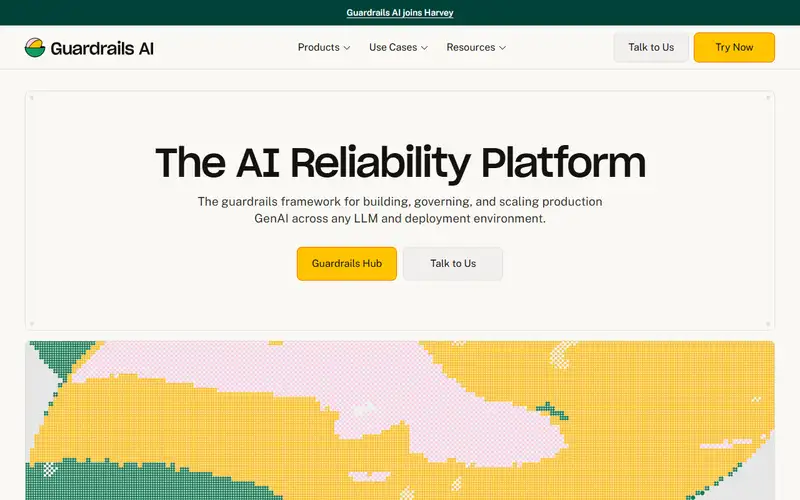
Guardrails AI sits between your application and a model, validating what goes in and what comes back. The checks are of two kinds: structural, so that what the model returns can actually be parsed and used, and policy-based, so that outputs meet rules you have set about content, safety or format. It ships as a library with a server option, and it is open source, so the validators can be read and extended.
The structural half is the more underrated one. Anyone who has shipped an LLM feature has written the same defensive parsing code, and any validation framework worth adopting has to make that disappear rather than add another layer to it. The policy half answers a different need — it is the mechanism by which you refuse to be the system that emitted something it should not have. What it cannot do is decide what your policy should be, and a validator that a model itself evaluates inherits that model's reliability, so the rules that matter still deserve deterministic checks wherever the input allows one.
Sources
The factual claims in this review were read from the pages below. Each date is when an editor last opened the source, not when the product changed.
- Vendor site Checked 2026-09-19
- Vendor documentation Checked 2026-09-19
Pros / Cons
Pros
- Removes hand-written defensive parsing rather than adding to it
- Open source, so validators can be inspected and extended
- Covers both structure and policy, which are separate failures
Cons
- Validators that are themselves model-judged inherit that model's unreliability
- It enforces your policy; it does not tell you what the policy should be
- Adding a validation pass costs latency on every call
Who it's for
Guaranteeing parseable structured output
Blocking disallowed content before it reaches a user
Enforcing format rules the model does not reliably follow
Adding policy checks to an existing LLM application
Bottom line
A validation layer for LLM I/O that earns its place by deleting defensive parsing code — and that cannot decide your policy for you.
Key Features
Tags
Frequently asked questions
Is Guardrails AI currently available?
No lifecycle review is recorded for this listing. Its inclusion in the directory does not confirm current availability; check the vendor before relying on it.
What is Guardrails AI?
Guardrails AI is a AI Platforms tool developed by Guardrails AI. Validation and control layer for LLM outputs, checking structure, safety and policy compliance on the way in and out.
Is Guardrails AI free?
Guardrails AI uses a freemium model: a free tier is available, and paid plans unlock more usage and advanced features.
Is Guardrails AI open source?
Yes — Guardrails AI is open source. The source code is publicly available at https://github.com/guardrails-ai/guardrails.
What are the best alternatives to Guardrails AI?
Notable AI Platforms alternatives include Hugging Face, Replicate, Ollama. Browse all 138 tools in our AI Platforms category for a full overview.
Was this listing useful?
Basic Info
- Pricing
- Freemium
- Editorial score
- ★ 4.2 / 5 How we score
- Platforms
- LibraryAPI
- Last verified
- Not recorded