MLflow
Product status: Status not recorded
No lifecycle review is recorded for this listing. Its inclusion in the directory does not confirm current availability; check the vendor before relying on it.
No status check date recorded
Open-source platform for tracking experiments, evaluating and registering models, and tracing LLM applications and agents. No lifecycle review is recorded for this listing. Its inclusion in the directory does not confirm current availability; check the vendor before relying on it.
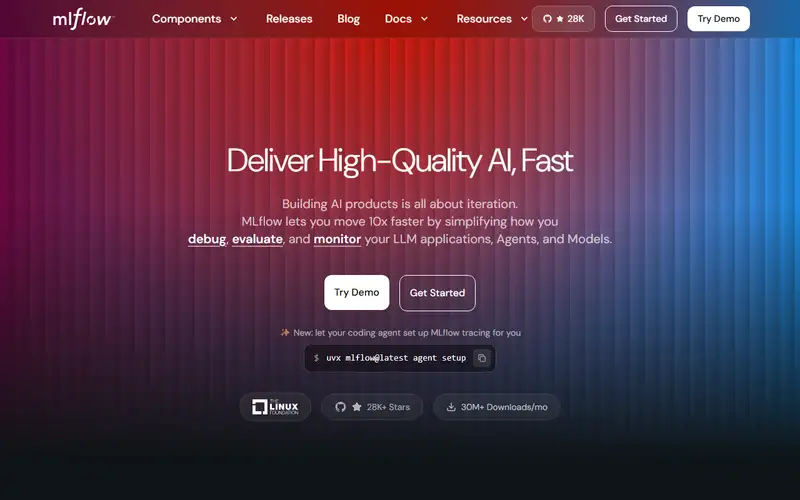
Product preview
Overview
MLflow is the open-source answer to experiment tracking and the ML lifecycle: log runs, compare them, register and deploy models, evaluate results, and — in its newer half — trace LLM applications and agents on OpenTelemetry. It runs locally or on your own infrastructure, and its adoption is measured in tens of millions of downloads a month, which is the number that matters for a tool whose value is partly that other people already use it.
The trade-off against a hosted platform is the usual open-source one, and it cuts both ways. You keep the data, you can read and modify the code, and there is no per-seat bill — but you also run the server, the storage and the upgrades, and the polished collaboration features of a commercial product are not the thing you are buying. Its other distinguishing fact is its owner: MLflow comes out of Databricks, so the direction of the project is set by a company with a commercial platform of its own, which is worth knowing when you decide how much of your workflow to build on it.
Sources
The factual claims in this review were read from the pages below. Each date is when an editor last opened the source, not when the product changed.
- Vendor site Checked 2026-09-19
- Vendor documentation Checked 2026-09-19
Pros / Cons
Pros
- Open source and self-hostable, so the run history and data stay under your control
- No per-seat cost, which matters at team scale
- Covers the lifecycle from tracking through registry to LLM tracing rather than one slice of it
Cons
- You operate the server, storage and upgrades yourself
- The project's direction is set by Databricks, which sells a competing commercial platform
- Collaboration and UI polish are not what an open-source project optimises for
Who it's for
Tracking experiments without a hosted service
Registering and deploying models from a self-hosted server
Tracing LLM applications and agents
Keeping an audit trail of model versions
Bottom line
The default open-source choice for tracking and the ML lifecycle, with the cost moved from licence fees to your own operations.
Key Features
Tags
Frequently asked questions
Is MLflow currently available?
No lifecycle review is recorded for this listing. Its inclusion in the directory does not confirm current availability; check the vendor before relying on it.
What is MLflow?
MLflow is a AI Platforms tool developed by Databricks. Open-source platform for tracking experiments, evaluating and registering models, and tracing LLM applications and agents.
Is MLflow free?
Yes — MLflow is free to use.
Is MLflow open source?
Yes — MLflow is open source. The source code is publicly available at https://github.com/mlflow/mlflow.
What are the best alternatives to MLflow?
Notable AI Platforms alternatives include Hugging Face, Replicate, Ollama. Browse all 138 tools in our AI Platforms category for a full overview.
Was this listing useful?
Basic Info
- Pricing
- Free
- Editorial score
- ★ 4.5 / 5 How we score
- Platforms
- LibraryWebAPI
- Last verified
- Not recorded