Modal
Modal Labs
★ #28 in AI PlatformsProduct status: Status not recorded
No lifecycle review is recorded for this listing. Its inclusion in the directory does not confirm current availability; check the vendor before relying on it.
No status check date recorded
Cloud execution for code-defined GPU/CPU functions, batches, training and sandboxes, with separate compute and model-endpoint billing. No lifecycle review is recorded for this listing. Its inclusion in the directory does not confirm current availability; check the vendor before relying on it.
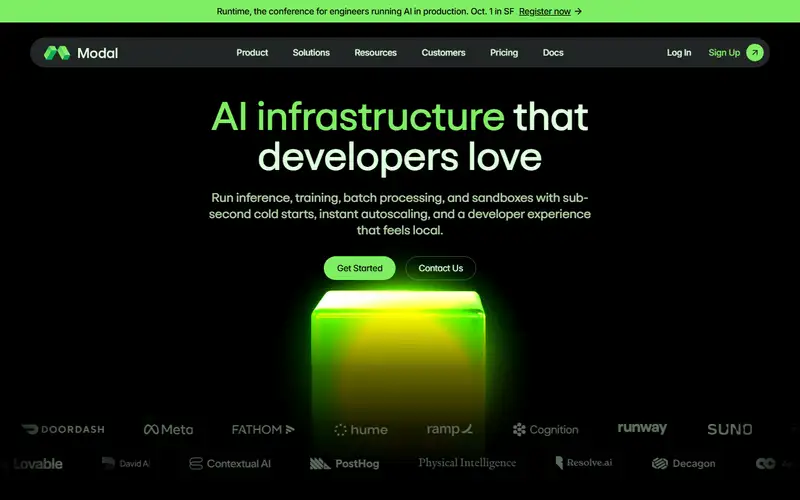
Product preview
Decision notes
Official-document research
Based on the cited documentation. We did not use the product, purchase a plan, or run quality, speed or reliability tests in this review.
Consider it for
- Teams prepared to manage Python jobs, budgets and model permissions
Choose another approach if
- Work requiring every product to retain no data
- Assuming monthly free compute covers all API tokens
Pricing and conditions
Documented terms
Displayed $ has no separately verified ISO currency; taxes are additional and regional tax is unconfirmed. Starter $0 + compute/month includes $30 compute and 3 seats; Team $250 + compute/month includes $100. Function rates include H100 SXM5 $0.001097/second, CPU $0.0000131/physical-core-second and memory $0.00000222/GiB-second; Sandbox/Notebook rates differ. Loading/processing and the default configurable 60-second warm period are billable; CPU/memory charge the higher of requested or actual use. Region selection is 1.15–1.75× and non-preemptible execution 3× base prices. Shared Endpoints bill tokens from the first request, outside monthly compute allowance. Credits expiry, actual model rates, order commitments and local totals need confirmation.
Pricing source read:
Pricing or terms sourceCode, model and service licensing
The hosted SaaS is proprietary, for internal business use, with restrictions on direct resale and third-party access subject to the order; its Apache-2.0 client is separate and requires licence/notices and modification markings on redistribution. Customer Data, including AI input/output, remains the customer's as between the parties; Modal has a service-purpose licence, and training or LLM ingestion requires prior written consent. Anonymous aggregate Service Metrics have separate business-use rights. This grants no rights to third-party weights, datasets or output content. Retention differs: Function IO up to 7 days, logs 1 day Starter/30 Team, persistent files until deletion, metadata for account life; endpoint payload ZDR does not cover every product or external provider.
Basis and limits of the recorded score
Original 4.6/5 retained; its original scoring worksheet and hands-on evidence are unavailable. This documentation review did not re-score it.
Overview
Modal runs code-defined containers on hosted CPU/GPU capacity for functions, batch jobs, training, sandboxes and notebooks. Python is the main language for implementing functions; JavaScript/TypeScript and Go can call functions and manage resources.
Choose the execution product before estimating cost or data exposure. Function loading and warm-container time can be billable; shared inference endpoints use token billing and do not consume included compute credits. Endpoint payload retention differs from Function inputs, logs and persistent volumes. Validate capacity, application access controls and model rights for your deployment.
Sources
The factual claims in this review were read from the pages below. Each date is when an editor last opened the source, not when the product changed.
- Vendor documentation Checked 2026-10-15
- Vendor pricing page Checked 2026-10-15
- Vendor documentation Checked 2026-10-15
- Vendor documentation Checked 2026-10-15
- Vendor documentation Checked 2026-10-15
- Vendor documentation Checked 2026-10-15
Pros / Cons
Pros
- Execution, resource configuration and deployment in code
- Documented per-resource prices and retention scopes
Cons
- Warm/loading time and regional multipliers affect bills
- Hosted runtime and product-specific retention need review
Who it's for
GPU batch processing and model jobs
Controlled agent sandboxes and notebook work
Bottom line
Evaluate Modal for hosted programmable compute after separating compute seconds, warm time and token endpoints.
Key Features
Tags
Frequently asked questions
Is Modal currently available?
No lifecycle review is recorded for this listing. Its inclusion in the directory does not confirm current availability; check the vendor before relying on it.
What is Modal?
Modal is a AI Platforms tool developed by Modal Labs. Cloud execution for code-defined GPU/CPU functions, batches, training and sandboxes, with separate compute and model-endpoint billing.
What costs and terms should I check for Modal?
Displayed $ has no separately verified ISO currency; taxes are additional and regional tax is unconfirmed. Starter $0 + compute/month includes $30 compute and 3 seats; Team $250 + compute/month includes $100. Function rates include H100 SXM5 $0.001097/second, CPU $0.0000131/physical-core-second and memory $0.00000222/GiB-second; Sandbox/Notebook rates differ. Loading/processing and the default configurable 60-second warm period are billable; CPU/memory charge the higher of requested or actual use. Region selection is 1.15–1.75× and non-preemptible execution 3× base prices. Shared Endpoints bill tokens from the first request, outside monthly compute allowance. Credits expiry, actual model rates, order commitments and local totals need confirmation.
Is Modal open source?
The hosted SaaS is proprietary, for internal business use, with restrictions on direct resale and third-party access subject to the order; its Apache-2.0 client is separate and requires licence/notices and modification markings on redistribution. Customer Data, including AI input/output, remains the customer's as between the parties; Modal has a service-purpose licence, and training or LLM ingestion requires prior written consent. Anonymous aggregate Service Metrics have separate business-use rights. This grants no rights to third-party weights, datasets or output content. Retention differs: Function IO up to 7 days, logs 1 day Starter/30 Team, persistent files until deletion, metadata for account life; endpoint payload ZDR does not cover every product or external provider.
What are the best alternatives to Modal?
Notable AI Platforms alternatives include Hugging Face, Replicate, Ollama. Browse all 138 tools in our AI Platforms category for a full overview.
Was this listing useful?
Basic Info
- Pricing
- Pay-as-you-go
Displayed $ has no separately verified ISO currency; taxes are additional and regional tax is unconfirmed. Starter $0 + compute/month includes $30 compute and 3 seats; Team $250 + compute/month includes $100. Function rates include H100 SXM5 $0.001097/second, CPU $0.0000131/physical-core-second and memory $0.00000222/GiB-second; Sandbox/Notebook rates differ. Loading/processing and the default configurable 60-second warm period are billable; CPU/memory charge the higher of requested or actual use. Region selection is 1.15–1.75× and non-preemptible execution 3× base prices. Shared Endpoints bill tokens from the first request, outside monthly compute allowance. Credits expiry, actual model rates, order commitments and local totals need confirmation.
- Editorial score
- ★ 4.6 / 5 How we score
- Platforms
- WebAPI
- Last verified
- Not recorded