Omnivore
Product status: Status not recorded
No lifecycle review is recorded for this listing. Its inclusion in the directory does not confirm current availability; check the vendor before relying on it.
No status check date recorded
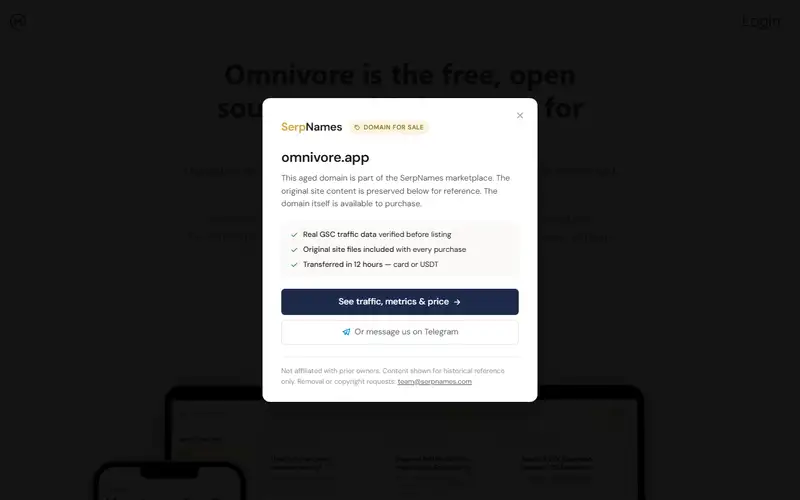
Open-source read-it-later: highlights, labels and a library you host yourself. The hosted app was discontinued and omnivore.app is no longer the project’s site — it now resolves to a domain-sale page — so what survives is the code, which was still receiving commits on 2026-09-19. No lifecycle review is recorded for this listing. Its inclusion in the directory does not confirm current availability; check the vendor before relying on it.
Product preview
Overview
Omnivore is an open-source read-it-later library: capture articles, pages and PDFs as clean text, then mark them up and read them offline. The feature set is unusually complete for the category — highlights and labels, full-text search, text-to-speech on iOS, an API, and iOS, Android and browser-extension clients — all under the AGPL-3.0 license. What changed is the hosting. The README states that the cloud app was deprecated in November 2024 and that Omnivore is now 'completely self-hosted': you run the server yourself, a Docker Compose stack with its own database, and point the clients at your instance. The hosted service is gone, the old app domain no longer belongs to the project, and the repository is the project's only home.
That makes Omnivore a sovereignty play, not a convenience play. You get a read-later archive no company can delist, reprice or shut down — but the vendor is now you: you patch the updates, back up the database, and fix sync yourself the day a mobile client stops talking to your build. Check the commit history before betting a decade of highlights on a repo whose maintenance depends on whoever still cares. If your 'later' pile is personal, text-first and you have a NAS to host it on, this is a genuinely rare thing: an archive you own. If you just want the pile to work without any ops at all, pick a hosted reader instead and spend zero minutes on servers.
Sources
The factual claims in this review were read from the pages below. Each date is when an editor last opened the source, not when the product changed.
- Vendor site Checked 2026-09-20
Pros / Cons
Pros
- A later queue you can host
- Highlights and labels
- Open source
- No landlord
Cons
- Hosted app winding down
- You run more of it
- Not Instapaper's Kindle
Who it's for
Self-hosting read-later
Highlights you own
Leaving Instapaper for the license
An open library of later
Bottom line
Sovereign later — Omnivore if you should host the queue, Instapaper if it should just work.
Key Features
Tags
Frequently asked questions
Is Omnivore currently available?
No lifecycle review is recorded for this listing. Its inclusion in the directory does not confirm current availability; check the vendor before relying on it.
What is Omnivore?
Omnivore is a Productivity tool developed by Omnivore. It was introduced in 2022, and its developer is headquartered in Open source. Open-source read-it-later: highlights, labels and a library you host yourself. The hosted app was discontinued and omnivore.app is no longer the project’s site — it now resolves to a domain-sale page — so what survives is the code, which was still receiving commits on 2026-09-19.
Is Omnivore free?
Yes — Omnivore is free to use.
Is Omnivore open source?
Yes — Omnivore is open source. The source code is publicly available at https://github.com/omnivore-app/omnivore.
What are the best alternatives to Omnivore?
Notable Productivity alternatives include Notion AI, Grammarly, Canva AI. Browse all 159 tools in our Productivity category for a full overview.
Was this listing useful?
Basic Info
- Pricing
- Free
- Editorial score
- ★ 4.5 / 5 How we score
- Platforms
- Self-hostedCLI
- Launched
- 2022
- Headquarters
- Open source
- Last verified
- 2026-09-20