
OpenAI Swarm
Product status: Status not recorded
No lifecycle review is recorded for this listing. Its inclusion in the directory does not confirm current availability; check the vendor before relying on it.
No status check date recorded
OpenAI's educational agent sketch: routines and handoffs in a few hundred lines — the blueprint the Agents SDK shipped. No lifecycle review is recorded for this listing. Its inclusion in the directory does not confirm current availability; check the vendor before relying on it.
Product preview
Overview
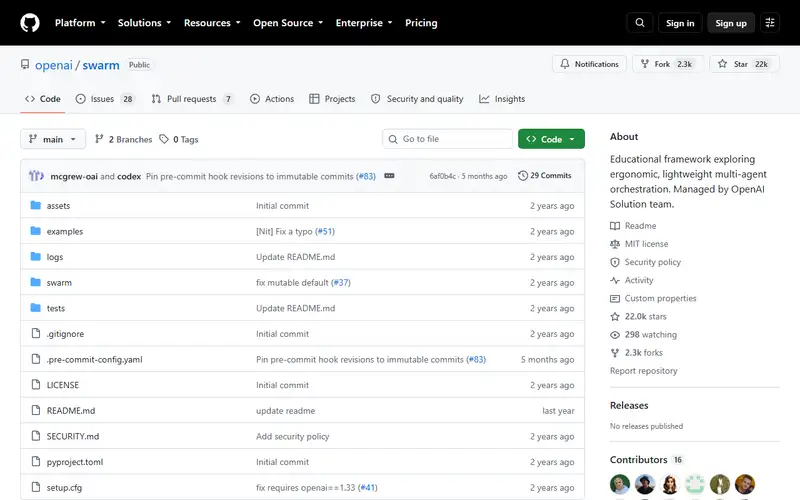
Swarm is OpenAI's teaching version of multi-agent orchestration: an MIT-licensed repository from its Solutions team, still headed 'experimental, educational' in the README. An agent is instructions plus Python functions, and only two operations exist — a routine, which loops over tool calls until the agent answers, and a handoff, where one agent returns another to carry on. There is no graph, no state store, no memory and no scheduler; the loop is plain code over the chat-completions interface, readable in an afternoon. That is why it mattered: it named the handoff pattern larger frameworks had buried in their machinery.
Judgement: on 2026-09-20 the repository is public, unarchived but effectively frozen — newest commit 15 April 2026, the one before it March 2025 — and the README states plainly that Swarm 'is now replaced by the OpenAI Agents SDK', recommending migration for production use. Maintenance went to the successor, which published v0.22.3 on 17 September 2026 and was still taking commits the day this was checked. It installs from git over SSH, so there is no version to pin, no changelog and no upgrade path. Nothing needs hosting: it is client code, so an API key is the only requirement, and it targets the older chat-completions shape, not the responses APIs current SDKs use. No streaming controls, guardrails, tracing or sessions ship with it, and it loses anywhere a run must survive a restart. Read it, teach handoffs from it, then build on the Agents SDK.
Sources
The factual claims in this review were read from the pages below. Each date is when an editor last opened the source, not when the product changed.
- Vendor documentation Checked 2026-09-20
- Vendor documentation Checked 2026-09-20
Pros / Cons
Pros
- Read the whole framework in an afternoon
- Handoffs as a first-class concept
- Written by the model maker
- Zero magic to debug
Cons
- Explicitly experimental, no support
- Not for production
- Superseded by the Agents SDK
Who it's for
Learning how agent handoffs work
Prototyping a router of specialists
Teaching multi-agent patterns
Reading before adopting the Agents SDK
Bottom line
Agents as homework — Swarm to learn the pattern, the Agents SDK to ship it.
Key Features
Tags
Frequently asked questions
Is OpenAI Swarm currently available?
No lifecycle review is recorded for this listing. Its inclusion in the directory does not confirm current availability; check the vendor before relying on it.
What is OpenAI Swarm?
OpenAI Swarm is a Code Generation tool developed by OpenAI. It was introduced in 2024, and its developer is headquartered in San Francisco, USA. OpenAI's educational agent sketch: routines and handoffs in a few hundred lines — the blueprint the Agents SDK shipped.
Is OpenAI Swarm free?
Yes — OpenAI Swarm is free to use.
Is OpenAI Swarm open source?
Yes — OpenAI Swarm is open source. The source code is publicly available at https://github.com/openai/swarm.
What are the best alternatives to OpenAI Swarm?
Notable Code Generation alternatives include GitHub Copilot, Cursor, Replit Agent. Browse all 76 tools in our Code Generation category for a full overview.
Was this listing useful?
Basic Info
- Pricing
- Free
- Editorial score
- ★ 4.2 / 5 How we score
- Platforms
- PythonGitHub
- Launched
- 2024
- Headquarters
- San Francisco, USA
- Last verified
- Not recorded