
OpenRouter
OpenRouter
★ #57 in AI PlatformsProduct status: Status not recorded
No lifecycle review is recorded for this listing. Its inclusion in the directory does not confirm current availability; check the vendor before relying on it.
No status check date recorded
A unified API that routes requests to hundreds of models from every major lab, with price and latency comparisons and automatic fallbacks. No lifecycle review is recorded for this listing. Its inclusion in the directory does not confirm current availability; check the vendor before relying on it.
Product preview
Overview
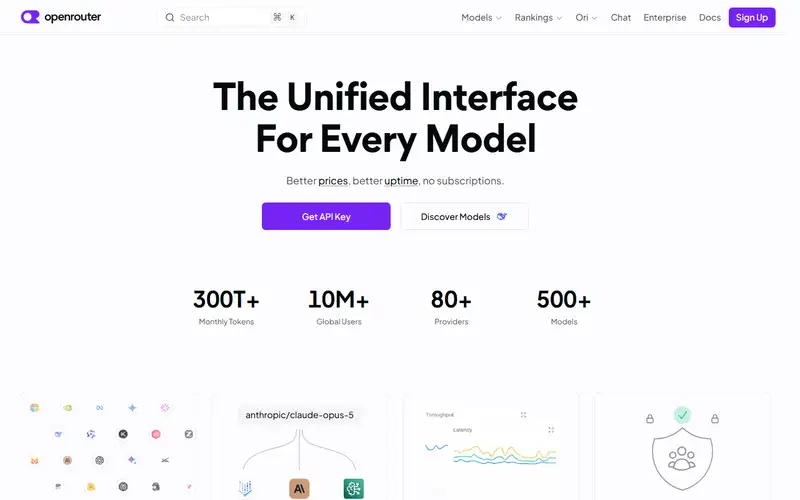
OpenRouter is a routing layer with a marketplace bolted on: one endpoint, 500+ models from dozens of providers, price and latency shown side by side, plus the plumbing that makes model choice reversible — automatic fallback chains when a provider degrades, routing parameters that sort candidates by cost, speed or tool-calling reliability, and provider filters you can pin to policy. Billing runs on prepaid credits, and token rates pass through at the upstream list price: what OpenRouter adds is 5.5% on credit purchases ($0.80 minimum; 5% for crypto), not a per-token markup. Bring-your-own-key works too, prompt logging is off unless you enable it, and providers can be filtered to ones that do not train on inputs.
Where it loses: capacity is not yours. Rate limits belong to the providers behind the router, outages travel through the fallback chain, and vendor-specific features — caching semantics, structured-output dialects, fine-tuning — arrive late or never, so teams leaning on the advanced surface of one lab API often go direct anyway. The contract, the DPA and the model terms sit with the provider, not the router. Pick it if your cost curve depends on swapping checkpoints weekly, or if you need a fallback rather than a hero model. Check the credit fee against your volume, the throughput your tier gets per provider, and what happens when a slug is deprecated.
Sources
The factual claims in this review were read from the pages below. Each date is when an editor last opened the source, not when the product changed.
- Vendor site Checked 2026-09-20
- Vendor site Checked 2026-09-20
- Vendor documentation Checked 2026-09-20
Pros / Cons
Pros
- One API for hundreds of models
- Live price/latency leaderboards
- Automatic provider failover
- No model lock-in
Cons
- Tokens billed at provider list price; margin is a 5.5% credit fee
- Newest models arrive with slight delay
- Advanced provider features may not pass through
Who it's for
Switching models without code changes
Comparing provider costs in production
Fallback routing for reliability
Bottom line
OpenRouter is the pragmatic default for teams that want model choice as an operational property, not a rewrite.
Key Features
Tags
Frequently asked questions
Is OpenRouter currently available?
No lifecycle review is recorded for this listing. Its inclusion in the directory does not confirm current availability; check the vendor before relying on it.
What is OpenRouter?
OpenRouter is a AI Platforms tool developed by OpenRouter. It was introduced in 2023, and its developer is headquartered in Remote / USA. A unified API that routes requests to hundreds of models from every major lab, with price and latency comparisons and automatic fallbacks.
Is OpenRouter free?
OpenRouter uses pay-as-you-go pricing, so costs scale with how much you use it.
Is OpenRouter open source?
No — OpenRouter is proprietary software.
What are the best alternatives to OpenRouter?
Notable AI Platforms alternatives include Hugging Face, Replicate, Ollama. Browse all 138 tools in our AI Platforms category for a full overview.
Was this listing useful?
Basic Info
- Pricing
- Pay-as-you-go
- Editorial score
- ★ 4.5 / 5 How we score
- Platforms
- WebAPI
- Launched
- 2023
- Headquarters
- Remote / USA
- Last verified
- Not recorded