
Orca
Product status: Status not recorded
No lifecycle review is recorded for this listing. Its inclusion in the directory does not confirm current availability; check the vendor before relying on it.
No status check date recorded
An agent development environment for running several coding agents in parallel across isolated worktrees. No lifecycle review is recorded for this listing. Its inclusion in the directory does not confirm current availability; check the vendor before relying on it.
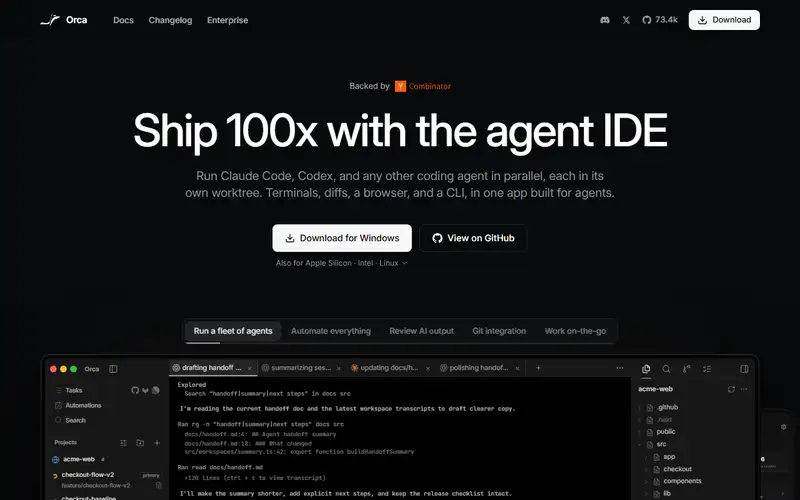
Product preview
Overview
Orca runs several coding agents at once, each in its own isolated git worktree, and gives you a single view of the fleet. It drives the CLI agents you already use — Claude Code, Codex, Gemini and others — from a desktop application, with a mobile companion for checking on work in progress.
The worktree isolation is the part that makes the rest possible, and it is worth understanding why. Two agents editing the same checkout will corrupt each other's work in ways that look like model unreliability: a file changes under an agent mid-task, tests fail for reasons that no longer exist, and the diff that comes back is not the change that was requested. Isolating each agent in its own worktree removes the interference and moves the hard problem to the join — several branches to review and reconcile, possibly touching the same code. So parallelism converts a coordination problem inside one task into a merge problem across several, which is usually the better trade but not a free one.
Sources
The factual claims in this review were read from the pages below. Each date is when an editor last opened the source, not when the product changed.
- Vendor site Checked 2026-09-19
- Vendor documentation Checked 2026-09-19
Pros / Cons
Pros
- Worktree isolation removes the interference that makes parallel agents look unreliable
- Drives the CLI agents you already pay for rather than replacing them
- A fleet view, which is what you need once several agents are running
Cons
- Parallelism trades an in-task coordination problem for a merge problem across branches
- Running several agents multiplies token spend, which the speed framing hides
- The claimed speed-up was not measured here
Who it's for
Running several agents on separate tasks at once
Keeping agents from interfering in one checkout
Supervising a fleet of coding agents
Checking on long-running agent work from a phone
Bottom line
Isolated worktrees as the answer to parallel agents — the isolation solves the real problem, and the merge is the bill that arrives later.
Key Features
Tags
Frequently asked questions
Is Orca currently available?
No lifecycle review is recorded for this listing. Its inclusion in the directory does not confirm current availability; check the vendor before relying on it.
What is Orca?
Orca is a Agents & Developer Tooling tool developed by Orca. An agent development environment for running several coding agents in parallel across isolated worktrees.
Is Orca free?
Orca uses a freemium model: a free tier is available, and paid plans unlock more usage and advanced features.
Is Orca open source?
Yes — Orca is open source. The source code is publicly available at https://github.com/stablyai/orca.
What are the best alternatives to Orca?
Notable Agents & Developer Tooling alternatives include Firecrawl, Browser Use, Daytona. Browse all 33 tools in our Agents & Developer Tooling category for a full overview.
Was this listing useful?
Basic Info
- Pricing
- Freemium
- Editorial score
- ★ 4.1 / 5 How we score
- Platforms
- DesktopCLIMobile
- Last verified
- Not recorded