Ponytail
Product status: Status not recorded
No lifecycle review is recorded for this listing. Its inclusion in the directory does not confirm current availability; check the vendor before relying on it.
No status check date recorded
Pushes coding agents toward the smallest working change: standard library over custom code, native over dependencies, one line over fifty. No lifecycle review is recorded for this listing. Its inclusion in the directory does not confirm current availability; check the vendor before relying on it.
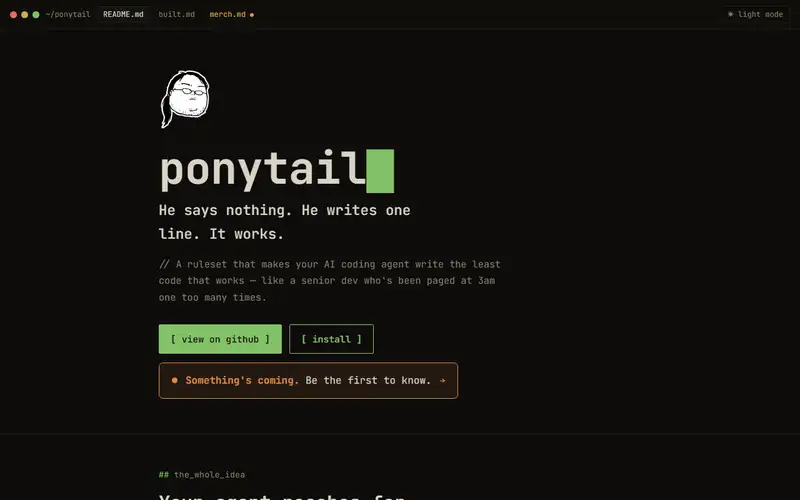
Product preview
Overview
Ponytail is a constraint you put on a coding agent's output: it pushes toward the smallest thing that works, preferring the standard library to new code, the platform to a dependency, and one line to fifty. Its claimed effect is a large reduction in generated code with no loss of safety.
The bias it corrects is not a model flaw but a training artefact. Models are rewarded for producing something that clearly works, and a visible, explicit implementation reads as more clearly correct than a terse one that leans on the standard library — so a fifty-line class can appear where a one-line comprehension belonged. The cost arrives later, as code someone has to read, review and maintain, and it compounds across a codebase. The caveat is that this is a heuristic applied to a judgement call: the terse version is sometimes genuinely worse, less clear to the next reader, and the reduction figure says nothing about which of those cases it produced. Treat it as a default that should be overridable, not a rule.
Sources
The factual claims in this review were read from the pages below. Each date is when an editor last opened the source, not when the product changed.
- Vendor site Checked 2026-09-19
- Vendor documentation Checked 2026-09-19
Pros / Cons
Pros
- Corrects a specific and real tendency: visible implementations preferred over shorter ones
- Reduces code that someone must read and maintain later
- A default you can override rather than a permanent constraint
Cons
- A heuristic applied to a judgement call: the terse version is sometimes genuinely worse
- The reduction figure says nothing about whether any individual change was the right one
- Its safety claim was not evaluated here
Who it's for
Keeping generated code reviewable
Reducing dependency sprawl introduced by agents
Setting a house default for how much code is acceptable
Cutting maintenance surface added by agent-written code
Bottom line
A constraint that makes agents write less code — correcting a real tendency, and best treated as an overridable default rather than a rule.
Key Features
Tags
Frequently asked questions
Is Ponytail currently available?
No lifecycle review is recorded for this listing. Its inclusion in the directory does not confirm current availability; check the vendor before relying on it.
What is Ponytail?
Ponytail is a Agents & Developer Tooling tool developed by Ponytail. Pushes coding agents toward the smallest working change: standard library over custom code, native over dependencies, one line over fifty.
Is Ponytail free?
Ponytail uses a freemium model: a free tier is available, and paid plans unlock more usage and advanced features.
Is Ponytail open source?
Yes — Ponytail is open source. The source code is publicly available at https://github.com/DietrichGebert/ponytail.
What are the best alternatives to Ponytail?
Notable Agents & Developer Tooling alternatives include Firecrawl, Browser Use, Daytona. Browse all 33 tools in our Agents & Developer Tooling category for a full overview.
Was this listing useful?
Basic Info
- Pricing
- Freemium
- Editorial score
- ★ 4.3 / 5 How we score
- Platforms
- PluginCLI
- Last verified
- Not recorded