
pyannote
Product status: Status not recorded
No lifecycle review is recorded for this listing. Its inclusion in the directory does not confirm current availability; check the vendor before relying on it.
No status check date recorded
Python speaker-diarization toolkit with separately licensed community models and paid cloud/on-premises offerings. No lifecycle review is recorded for this listing. Its inclusion in the directory does not confirm current availability; check the vendor before relying on it.
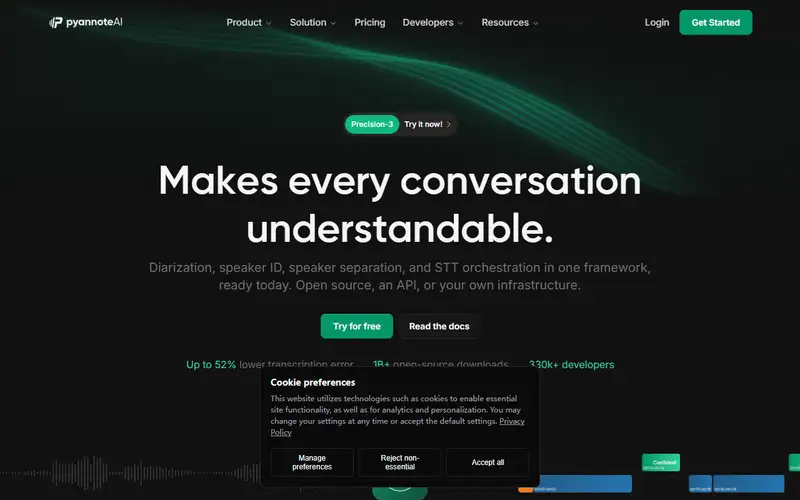
Product preview
Decision notes
Official-document research
Based on the cited documentation. We did not use the product, purchase a plan, or run quality, speed or reliability tests in this review.
Consider it for
- Developers able to review speaker assignments and manage audio consent
Choose another approach if
- Guaranteed speaker accuracy, zero-configuration transcription or assumed zero telemetry
Pricing and conditions
Documented terms
Cloud Developer EUR19/month includes EUR19 usage credit/1 seat; Starter EUR99/month includes EUR99/3 seats. Precision-3 rates are EUR0.112/0.096 per audio hour respectively; hosted Community-1 EUR0.035/hour. Included credit offsets usage; these are not unlimited-hour subscriptions. Terms default to tax-exclusive EUR, monthly actual usage and a 20-second minimum per file. Thirty-day trial hours differ across page sections (up to 170 vs a 150-hour identification example); confirm scope in account. Rollover, overage controls, regional totals and refunds unknown. Enterprise/on-premises custom quote; MIT toolkit has no software license fee but hardware/operations cost extra.
Pricing source read:
Pricing or terms sourceCode, model and service licensing
MIT covers toolkit code with notices; Community-1 weights use CC BY 4.0 with attribution/license/change notices and separate access conditions, not MIT. Other models need their own cards. Cloud output IP remains the customer's after payment, while resale of the service/account and training competing diarization from results/know-how are restricted. The service terms forbid pyannoteAI training/improving its models on customer audio/outputs without explicit customer consent. This is not zero retention: privacy leaves API storage duration to website rules. Local library telemetry is configurable; quoted on-premises terms keep audio local but permit billing/usage signals. Input and biometric-processing rights remain yours to establish.
Basis and limits of the recorded score
Original 4.5/5 retained; original scoring worksheet and hands-on evidence unavailable. Documentation review did not re-score.
Overview
pyannote.audio is a Python/PyTorch toolkit for identifying who spoke when. Community-1 can run locally after model download and access-condition acceptance. Precision examples call pyannoteAI servers; a Python interface does not make those requests local. Cloud plans and quoted on-premises deployment have separate service terms. Diarization is not itself a full transcription workflow, and errors need review.
Sources
The factual claims in this review were read from the pages below. Each date is when an editor last opened the source, not when the product changed.
- Vendor documentation Checked 2026-10-15
- Vendor documentation Checked 2026-10-15
- Vendor documentation Checked 2026-10-15
- Third-party report Checked 2026-10-15
- Vendor pricing page Checked 2026-10-15
- Vendor documentation Checked 2026-10-15
- Vendor documentation Checked 2026-10-15
Pros / Cons
Pros
- Local community and hosted deployment paths
- Explicit code, model and service terms
Cons
- Dependencies, model access and speaker errors require engineering
- Cloud billing has per-file minimums; telemetry differs by deployment
Who it's for
Speaker-labelled transcript pipelines
Evaluating local Community-1 versus a contracted cloud/on-premises service
Bottom line
Pick the exact model and deployment, then check its license, audio permissions and billing minimums.
Key Features
Tags
Frequently asked questions
Is pyannote currently available?
No lifecycle review is recorded for this listing. Its inclusion in the directory does not confirm current availability; check the vendor before relying on it.
What is pyannote?
pyannote is a Audio Generation tool developed by pyannoteAI. Python speaker-diarization toolkit with separately licensed community models and paid cloud/on-premises offerings.
What costs and terms should I check for pyannote?
Cloud Developer EUR19/month includes EUR19 usage credit/1 seat; Starter EUR99/month includes EUR99/3 seats. Precision-3 rates are EUR0.112/0.096 per audio hour respectively; hosted Community-1 EUR0.035/hour. Included credit offsets usage; these are not unlimited-hour subscriptions. Terms default to tax-exclusive EUR, monthly actual usage and a 20-second minimum per file. Thirty-day trial hours differ across page sections (up to 170 vs a 150-hour identification example); confirm scope in account. Rollover, overage controls, regional totals and refunds unknown. Enterprise/on-premises custom quote; MIT toolkit has no software license fee but hardware/operations cost extra.
Is pyannote open source?
MIT covers toolkit code with notices; Community-1 weights use CC BY 4.0 with attribution/license/change notices and separate access conditions, not MIT. Other models need their own cards. Cloud output IP remains the customer's after payment, while resale of the service/account and training competing diarization from results/know-how are restricted. The service terms forbid pyannoteAI training/improving its models on customer audio/outputs without explicit customer consent. This is not zero retention: privacy leaves API storage duration to website rules. Local library telemetry is configurable; quoted on-premises terms keep audio local but permit billing/usage signals. Input and biometric-processing rights remain yours to establish.
What are the best alternatives to pyannote?
Notable Audio Generation alternatives include ElevenLabs, Suno, Udio. Browse all 51 tools in our Audio Generation category for a full overview.
Was this listing useful?
Basic Info
- Pricing
- Freemium
Cloud Developer EUR19/month includes EUR19 usage credit/1 seat; Starter EUR99/month includes EUR99/3 seats. Precision-3 rates are EUR0.112/0.096 per audio hour respectively; hosted Community-1 EUR0.035/hour. Included credit offsets usage; these are not unlimited-hour subscriptions. Terms default to tax-exclusive EUR, monthly actual usage and a 20-second minimum per file. Thirty-day trial hours differ across page sections (up to 170 vs a 150-hour identification example); confirm scope in account. Rollover, overage controls, regional totals and refunds unknown. Enterprise/on-premises custom quote; MIT toolkit has no software license fee but hardware/operations cost extra.
- Editorial score
- ★ 4.5 / 5 How we score
- Platforms
- LibraryPythonCloud
- Last verified
- Not recorded