
Ray
Product status: Status not recorded
No lifecycle review is recorded for this listing. Its inclusion in the directory does not confirm current availability; check the vendor before relying on it.
No status check date recorded
Distributed Python as a library: data, training, tuning, serving — Kubernetes' more Python-native cousin. No lifecycle review is recorded for this listing. Its inclusion in the directory does not confirm current availability; check the vendor before relying on it.
Product preview
Overview
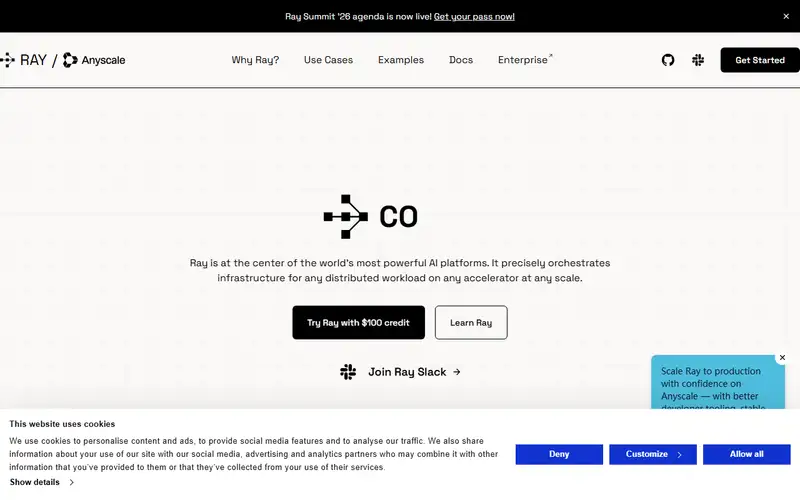
Ray is an Apache-2.0 distributed compute engine: a handful of primitives — tasks, actors, objects — that turn ordinary Python functions and classes into work scheduled across machines, with libraries on top: Ray Data, Train, Tune, RLlib and Serve for online inference. Serve is framework-agnostic — PyTorch, TensorFlow, scikit-learn or plain Python logic. Distinctive features: fractional GPUs, so several models share one card; model composition, where a pipeline of models and code is one Python program rather than several wired services; and LLM handling — response streaming, dynamic request batching, multi-GPU serving. KubeRay, a separate Apache-2.0 operator, runs clusters on Kubernetes. Release 2.58.0 shipped 2026-08-23.
Ray is infrastructure you operate, not a service you buy: it deletes the queue-and-thread layer and hands you a cluster in exchange. The laptop-to-thousands-of-GPUs claim is real, but assumes you will reason about object-store memory and scheduling. Read the security docs before a multi-team rollout: Ray serialises with cloudpickle, expects trusted code on an isolated network, does not isolate jobs inside a single cluster, and ships no developer access controls. Token authentication arrived in 2.52.0 but is documented as defence in depth, not a substitute for isolation. Anyscale, from Ray's own makers, is the managed answer, advertising a $100 starting credit and selling the governance, dashboard hardening and support the OSS build leaves to you.
Sources
The factual claims in this review were read from the pages below. Each date is when an editor last opened the source, not when the product changed.
- Vendor documentation Checked 2026-10-12
- Vendor documentation Checked 2026-10-12
- Vendor documentation Checked 2026-10-12
- Vendor pricing page Checked 2026-10-12
- Vendor documentation Checked 2026-10-12
- Vendor documentation Checked 2026-10-12
Pros / Cons
Pros
- From laptop to cluster without rewrites
- Serve, train, and data in one runtime
- The substrate under modern ML tooling
- Autoscaling that just behaves
Cons
- Debugging distributed failures stays hard
- Dashboard is a must, not a luxury
- Kubernetes often under it anyway
Who it's for
Scaling Python ML workloads
Inference clusters via Ray Serve
Hyperparameter search at scale
Data pipelines for training sets
Bottom line
Python as a cluster — Ray to distribute the functions, Kubernetes to schedule the containers.
Key Features
Tags
Frequently asked questions
Is Ray currently available?
No lifecycle review is recorded for this listing. Its inclusion in the directory does not confirm current availability; check the vendor before relying on it.
What is Ray?
Ray is a AI Platforms tool developed by Anyscale. It was introduced in 2017, and its developer is headquartered in San Francisco, USA. Distributed Python as a library: data, training, tuning, serving — Kubernetes' more Python-native cousin.
Is Ray free?
Ray uses a freemium model: a free tier is available, and paid plans unlock more usage and advanced features.
Is Ray open source?
Yes — Ray is open source. The source code is publicly available at https://github.com/ray-project/ray.
What are the best alternatives to Ray?
Notable AI Platforms alternatives include Hugging Face, Replicate, Ollama. Browse all 138 tools in our AI Platforms category for a full overview.
Was this listing useful?
Basic Info
- Pricing
- Freemium
- Editorial score
- ★ 4.5 / 5 How we score
- Platforms
- LibraryClusterCloud
- Launched
- 2017
- Headquarters
- San Francisco, USA
- Last verified
- Not recorded