
Semantic Kernel
Product status: Status not recorded
No lifecycle review is recorded for this listing. Its inclusion in the directory does not confirm current availability; check the vendor before relying on it.
No status check date recorded
Microsoft MIT SDK for integrating models and plugins; assess Agent Framework migration separately for new work. No lifecycle review is recorded for this listing. Its inclusion in the directory does not confirm current availability; check the vendor before relying on it.
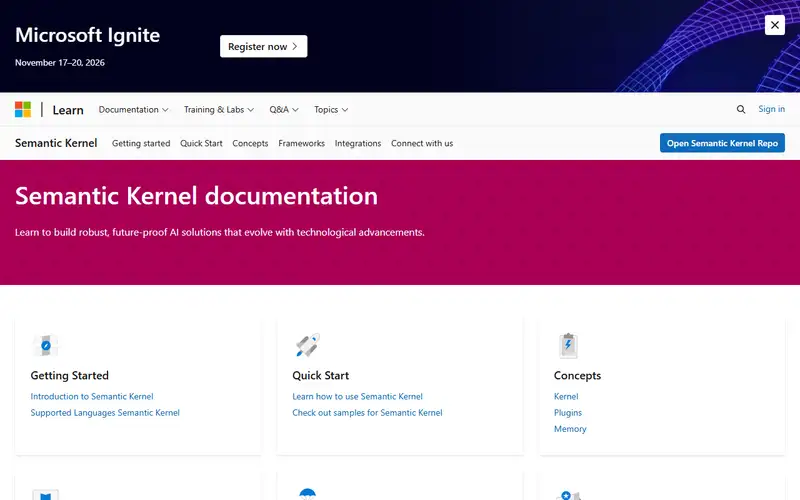
Product preview
Decision notes
Official-document research
Based on the cited documentation. We did not use the product, purchase a plan, or run quality, speed or reliability tests in this review.
Consider it for
- Teams owning existing Semantic Kernel applications and their integration contracts
Choose another approach if
- Assuming all model backends are interchangeable
- A promise of future-proof code or automatic migration
Pricing and conditions
Documented terms
MIT SDK code has no software royalty. Model inference, cloud resources, storage and operations can be billed separately. No unified hosted package, currency, tax or provider quota is established by the code license; obtain pricing for the actual backend and any successor service.
Pricing source read:
Pricing or terms sourceCode, model and service licensing
MIT covers SDK code with notice obligations, not hosted models, provider resources, inputs or output rights. Data routing, training and retention follow the chosen services and contracts; hosted session deletion depends on the provider, so local SDK use is not a local-only history guarantee. Those provider contracts were not verified in this review.
Basis and limits of the recorded score
Original 4.5/5 retained; the original scoring worksheet and hands-on evidence are unavailable. This documentation review did not re-score it.
Overview
Semantic Kernel connects models, functions and plugins in application code. Its current repository points to Microsoft Agent Framework 1.0 as the successor; that does not rename this SDK or prove existing Semantic Kernel applications have stopped working. The older overview and preview-era support FAQ have different publication contexts.
Existing users should review dependencies and the support commitment; new projects should assess the migration guide rather than assume a drop-in replacement. Namespaces, provider resources and session behavior differ. The FAQ describes critical/security maintenance and at least one year after Agent Framework GA, not a verified final shutdown date. Performance, compatibility and automatic migration were not tested.
Sources
The factual claims in this review were read from the pages below. Each date is when an editor last opened the source, not when the product changed.
- Vendor documentation Checked 2026-10-15
- Vendor documentation Checked 2026-10-15
- Vendor documentation Checked 2026-10-15
- Vendor documentation Checked 2026-10-15
- Vendor documentation Checked 2026-10-15
Pros / Cons
Pros
- Documented model and plugin interfaces
- Public code and official migration guidance
Cons
- Successor migration needs design
- Cloud resources and history deletion vary by provider
Who it's for
Maintaining an existing SDK integration
Planning a controlled Agent Framework migration
Bottom line
Check existing support and provider dependencies, then scope migration explicitly.
Key Features
Tags
Frequently asked questions
Is Semantic Kernel currently available?
No lifecycle review is recorded for this listing. Its inclusion in the directory does not confirm current availability; check the vendor before relying on it.
What is Semantic Kernel?
Semantic Kernel is a Code Generation tool developed by Microsoft. Microsoft MIT SDK for integrating models and plugins; assess Agent Framework migration separately for new work.
What costs and terms should I check for Semantic Kernel?
MIT SDK code has no software royalty. Model inference, cloud resources, storage and operations can be billed separately. No unified hosted package, currency, tax or provider quota is established by the code license; obtain pricing for the actual backend and any successor service.
Is Semantic Kernel open source?
MIT covers SDK code with notice obligations, not hosted models, provider resources, inputs or output rights. Data routing, training and retention follow the chosen services and contracts; hosted session deletion depends on the provider, so local SDK use is not a local-only history guarantee. Those provider contracts were not verified in this review.
What are the best alternatives to Semantic Kernel?
Notable Code Generation alternatives include GitHub Copilot, Cursor, Replit Agent. Browse all 76 tools in our Code Generation category for a full overview.
Was this listing useful?
Basic Info
- Pricing
- Free
MIT SDK code has no software royalty. Model inference, cloud resources, storage and operations can be billed separately. No unified hosted package, currency, tax or provider quota is established by the code license; obtain pricing for the actual backend and any successor service.
- Editorial score
- ★ 4.5 / 5 How we score
- Platforms
- SDK.NETPythonJava
- Last verified
- Not recorded