Semantic Scholar
Allen Institute for AI
★ #46 in ProductivityProduct status: Status not recorded
No lifecycle review is recorded for this listing. Its inclusion in the directory does not confirm current availability; check the vendor before relying on it.
No status check date recorded
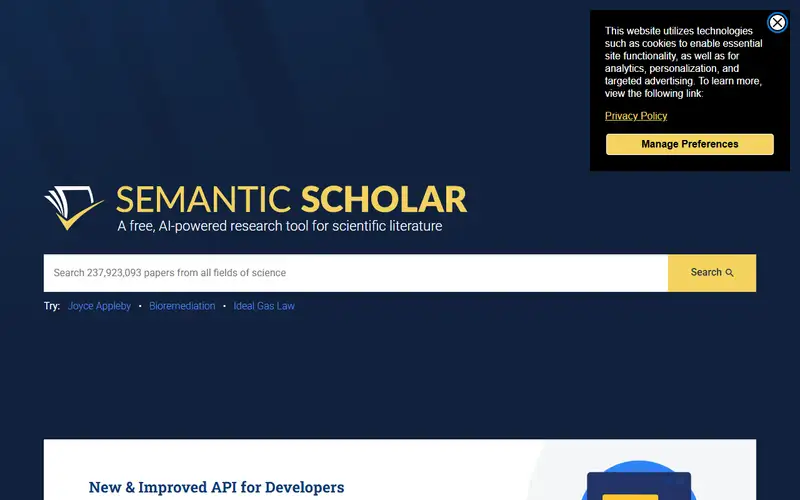
Ai2's free scientific-literature discovery service, with paper and citation information, limited-domain AI summaries and separately licensed API/data access. No lifecycle review is recorded for this listing. Its inclusion in the directory does not confirm current availability; check the vendor before relying on it.
Product preview
Decision notes
Official-document research
Based on the cited documentation. We did not use the product, purchase a plan, or run quality, speed or reliability tests in this review.
Consider it for
- Researchers checking papers and developers confirming API/data permissions
Choose another approach if
- All papers freely licensed or every summary verified
- Unlimited API throughput or assumed commercial permission
Pricing and conditions
Documented terms
The FAQ describes free Web research access and free account creation; publisher subscriptions and reuse rights are separate. API overview states unauthenticated traffic shares1000RPS across all users, may be further throttled, and keys start at1RPS; some endpoints require keys. This is not a personal throughput guarantee or blanket free commercial license. Expanded access, any fees/ISO currency/taxes/region, quota increases and dataset contracts were not confirmed. No account, key or API call was requested.
Pricing source read:
Pricing or terms sourceCode, model and service licensing
Free search is not an open-source, model or paper license. Authors/publishers and dataset licenses govern reuse. The May2023 API text separates S2 data licenses and permits input use to provide/improve services; the API-hosted agreement instead describes internal noncommercial research/education and expanded commercial permission, with a narrower input-use promise. Confirm the controlling channel/contract. General Ai2 terms reserve broad user-content licensing/training unless specific terms differ; they do not prove every API trains. Usage/account/search data and necessary/legal retention remain. No universal no-training or deletion deadline was verified.
Basis and limits of the recorded score
Original 4.6/5 retained; the original scoring worksheet and hands-on evidence are unavailable. This document review did not re-score it.
Overview
Semantic Scholar is Ai2's scientific-literature discovery service. Its FAQ describes search, libraries, alerts and research feeds; AI TLDR summaries are limited to available papers in computer science and biomedicine. Graph, recommendation and dataset APIs have separate access conditions.
Discovery does not confer access to every paywalled paper or permission to republish it. Read original sources and check licenses. The two published API agreements differ in permissions and data use, and the general Ai2 terms do not override every specific API/data contract.
Sources
The factual claims in this review were read from the pages below. Each date is when an editor last opened the source, not when the product changed.
- Vendor documentation Checked 2026-10-15
- Vendor documentation Checked 2026-10-15
- Vendor documentation Checked 2026-10-15
- Vendor documentation Checked 2026-10-15
- Vendor documentation Checked 2026-10-15
- Vendor documentation Checked 2026-10-15
Pros / Cons
Pros
- Free discovery and personal research organization
- Programmatic graph and dataset access is documented
Cons
- Summaries and corpus coverage have limits
- Paper rights and API contracts need separate checks
Who it's for
Finding papers for a reviewed literature survey
Building an authorized citation-data workflow
Bottom line
Use it to discover sources; check the paper, data license and actual API agreement before reuse.
Key Features
Tags
Frequently asked questions
Is Semantic Scholar currently available?
No lifecycle review is recorded for this listing. Its inclusion in the directory does not confirm current availability; check the vendor before relying on it.
What is Semantic Scholar?
Semantic Scholar is a Productivity tool developed by Allen Institute for AI. Ai2's free scientific-literature discovery service, with paper and citation information, limited-domain AI summaries and separately licensed API/data access.
What costs and terms should I check for Semantic Scholar?
The FAQ describes free Web research access and free account creation; publisher subscriptions and reuse rights are separate. API overview states unauthenticated traffic shares1000RPS across all users, may be further throttled, and keys start at1RPS; some endpoints require keys. This is not a personal throughput guarantee or blanket free commercial license. Expanded access, any fees/ISO currency/taxes/region, quota increases and dataset contracts were not confirmed. No account, key or API call was requested.
Is Semantic Scholar open source?
Free search is not an open-source, model or paper license. Authors/publishers and dataset licenses govern reuse. The May2023 API text separates S2 data licenses and permits input use to provide/improve services; the API-hosted agreement instead describes internal noncommercial research/education and expanded commercial permission, with a narrower input-use promise. Confirm the controlling channel/contract. General Ai2 terms reserve broad user-content licensing/training unless specific terms differ; they do not prove every API trains. Usage/account/search data and necessary/legal retention remain. No universal no-training or deletion deadline was verified.
What are the best alternatives to Semantic Scholar?
Notable Productivity alternatives include Notion AI, Grammarly, Canva AI. Browse all 159 tools in our Productivity category for a full overview.
Was this listing useful?
Basic Info
- Pricing
- Free
The FAQ describes free Web research access and free account creation; publisher subscriptions and reuse rights are separate. API overview states unauthenticated traffic shares1000RPS across all users, may be further throttled, and keys start at1RPS; some endpoints require keys. This is not a personal throughput guarantee or blanket free commercial license. Expanded access, any fees/ISO currency/taxes/region, quota increases and dataset contracts were not confirmed. No account, key or API call was requested.
- Editorial score
- ★ 4.6 / 5 How we score
- Platforms
- WebAPI
- Last verified
- Not recorded