
SGLang
Product status: Status not recorded
No lifecycle review is recorded for this listing. Its inclusion in the directory does not confirm current availability; check the vendor before relying on it.
No status check date recorded
The serving engine with RadixAttention: shared prefixes cached — vLLM's more prefix-aware cousin. No lifecycle review is recorded for this listing. Its inclusion in the directory does not confirm current availability; check the vendor before relying on it.
Product preview
Overview
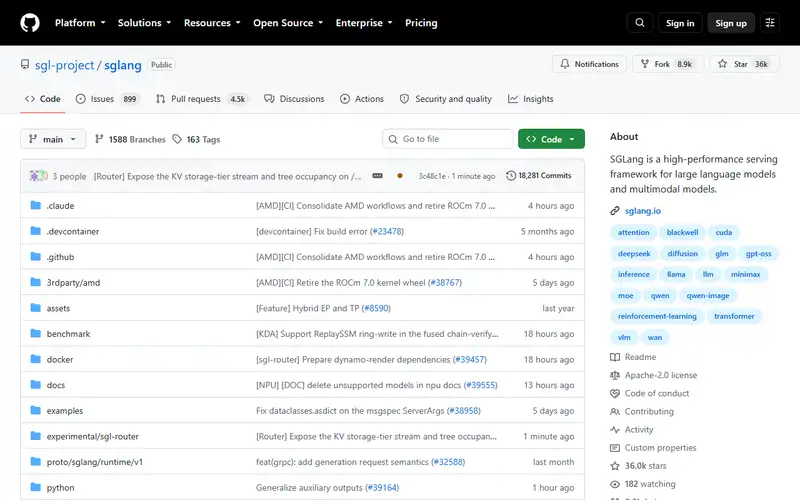
SGLang is an Apache-2.0 serving engine held by LMSYS, a non-profit, fronting language, multimodal, embedding, reward and diffusion models behind OpenAI-compatible endpoints. Its mechanism is RadixAttention: KV cache for shared prompt prefixes lives in a radix tree, so a long system prompt, a few-shot header or a repeating agent scaffold is computed once and reused across concurrent requests until evicted. Around it sit a zero-overhead CPU scheduler, continuous batching, paged attention, prefill-decode disaggregation, speculative decoding, four axes of parallelism, structured output via compressed finite-state machines, FP4/FP8/INT4/AWQ/GPTQ quantization and multi-LoRA batching. Install with pip, uv or Docker against CUDA 12.9 or 13.0; it runs on NVIDIA, AMD MI300/MI355, Intel Xeon, Google TPU and Ascend NPU.
The claim is throughput per GPU-hour; the project states deployment on 400,000-plus GPUs and integration with major RL frameworks — self-reported, so directional rather than audited; no adopting company is named on the pages read. Cadence is fast (v0.5.20 published 2026-09-18, repo pushed 2026-09-20) and the tuning surface is deep enough that someone has to own it. Two caveats: prefix caching only pays where prompts genuinely share a prefix, so single-shot unrelated queries gain little over any other engine; and there is no hosted SGLang and no price list — support is Slack, Discord and GitHub Discussions, with consulting by email. Free software whose real cost is your GPU time, your on-call rota and the flags you learn.
Sources
The factual claims in this review were read from the pages below. Each date is when an editor last opened the source, not when the product changed.
- Vendor documentation Checked 2026-10-12
- Vendor site Checked 2026-10-12
- Vendor documentation Checked 2026-10-12
Pros / Cons
Pros
- Prefix reuse slashes repeated compute
- Benchmark-topping throughput
- Structured decoding without stalls
- Backed by LMSYS research
Cons
- Younger ecosystem than vLLM
- Model coverage trails slightly
- Tuning knobs reward experts
Who it's for
Agents sharing long system prompts
Few-shot pipelines at scale
Structured JSON extraction farms
Batch inference cost cuts
Bottom line
Throughput through reuse — SGLang when prefixes repeat, vLLM when breadth rules.
Key Features
Tags
Frequently asked questions
Is SGLang currently available?
No lifecycle review is recorded for this listing. Its inclusion in the directory does not confirm current availability; check the vendor before relying on it.
What is SGLang?
SGLang is a AI Platforms tool developed by LMSYS. It was introduced in 2024, and its developer is headquartered in Berkeley, USA. The serving engine with RadixAttention: shared prefixes cached — vLLM's more prefix-aware cousin.
Is SGLang free?
Yes — SGLang is free to use.
Is SGLang open source?
Yes — SGLang is open source. The source code is publicly available at https://github.com/sgl-project/sglang.
What are the best alternatives to SGLang?
Notable AI Platforms alternatives include Hugging Face, Replicate, Ollama. Browse all 138 tools in our AI Platforms category for a full overview.
Was this listing useful?
Basic Info
- Pricing
- Free
- Editorial score
- ★ 4.5 / 5 How we score
- Platforms
- LibraryServing
- Launched
- 2024
- Headquarters
- Berkeley, USA
- Last verified
- Not recorded