
Text Generation Inference
Product status: Status not recorded
No lifecycle review is recorded for this listing. Its inclusion in the directory does not confirm current availability; check the vendor before relying on it.
No status check date recorded
Hugging Face's serving layer: open weights in, OpenAI-shaped LLM endpoints out, tuned for big batches. No lifecycle review is recorded for this listing. Its inclusion in the directory does not confirm current availability; check the vendor before relying on it.
Product preview
Overview
Text Generation Inference is Hugging Face's toolkit for serving open language models: load a model from the Hub, expose it through a compatible endpoint, and get continuous batching, tensor parallelism across several graphics cards, token streaming, quantisation, Flash Attention and Paged Attention, Open Telemetry tracing and Prometheus metrics without writing the server yourself. It grew out of the same work that made it normal for inference engines to reuse a transformers model definition.
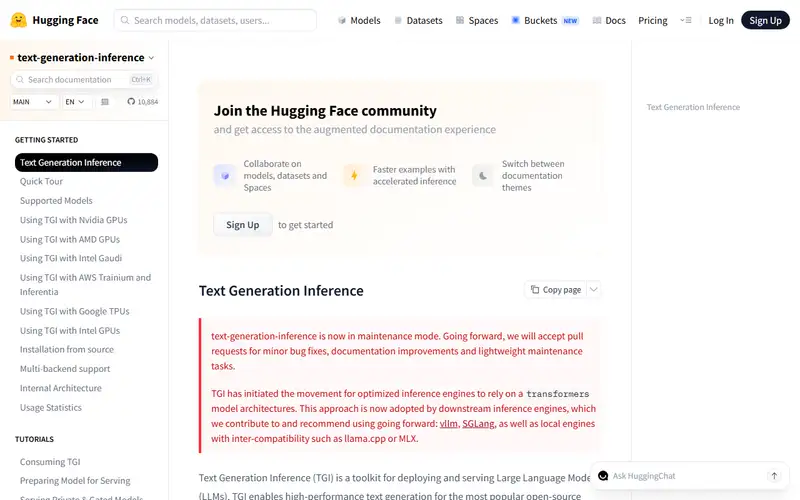
It is no longer a forward-looking choice, and that is now the most important thing about it. The documentation states that the project is in maintenance mode, accepting only minor bug fixes, documentation improvements and lightweight maintenance tasks, and that Hugging Face now contributes to and recommends other engines going forward — naming vLLM and SGLang, plus local engines with inter-compatibility such as llama.cpp and MLX. The repository is archived. So it suits teams that already run it and need the documented feature set, and it suits nobody choosing a serving layer for new work in 2026.
Not verified: what is inside the archive rather than the maintenance branch was not examined, so whether security fixes would still be accepted is unknown — the documentation's wording is about minor fixes and lightweight maintenance, and nothing read here promises otherwise. No server was started and no model was served, so throughput, the parallelism behaviour and the quantisation path were not measured. The feature list, including the tracing and metrics integrations, is taken from the project's own documentation page. The archived repository reported about 10,880 stars and the Apache-2.0 licence, with the last push dated 21 March 2026.
No content sources are recorded for this entry. Its inclusion and existing score do not establish that its claims have been independently verified.
Pros / Cons
Pros
- Hub models served in minutes
- Continuous batching for throughput
- Native Hugging Face integration
- Free and Apache-licensed
Cons
- Throughput race with vLLM stays close
- Enterprise features sit in the Hub tiers
- Quantization options fewer than vLLM
Who it's for
Serving Hub models in production
OpenAI-compatible endpoints on open weights
GPU clusters for private LLMs
Enterprise Hub deployments
Bottom line
Hugging Face's model server, now archived and in maintenance mode — use it if you already run it, and choose vLLM or SGLang for anything new.
Key Features
Tags
Frequently asked questions
Is Text Generation Inference currently available?
No lifecycle review is recorded for this listing. Its inclusion in the directory does not confirm current availability; check the vendor before relying on it.
What is Text Generation Inference?
Text Generation Inference is a AI Platforms tool developed by Hugging Face. It was introduced in 2022, and its developer is headquartered in Remote. Hugging Face's serving layer: open weights in, OpenAI-shaped LLM endpoints out, tuned for big batches.
Is Text Generation Inference free?
Yes — Text Generation Inference is free to use.
Is Text Generation Inference open source?
Yes — Text Generation Inference is open source. The source code is publicly available at https://github.com/huggingface/text-generation-inference.
What are the best alternatives to Text Generation Inference?
Notable AI Platforms alternatives include Hugging Face, Replicate, Ollama. Browse all 138 tools in our AI Platforms category for a full overview.
Was this listing useful?
Basic Info
- Pricing
- Free
- Editorial score
- ★ 4.4 / 5 How we score
- Platforms
- ServerDockerKubernetes
- Launched
- 2022
- Headquarters
- Remote
- Last verified
- Not recorded