
turbopuffer
turbopuffer
★ #127 in AI PlatformsProduct status: Status not recorded
No lifecycle review is recorded for this listing. Its inclusion in the directory does not confirm current availability; check the vendor before relying on it.
No status check date recorded
Vector and full-text search built on object storage rather than memory-resident indexes, priced as storage plus queries. No lifecycle review is recorded for this listing. Its inclusion in the directory does not confirm current availability; check the vendor before relying on it.
Product preview
Overview
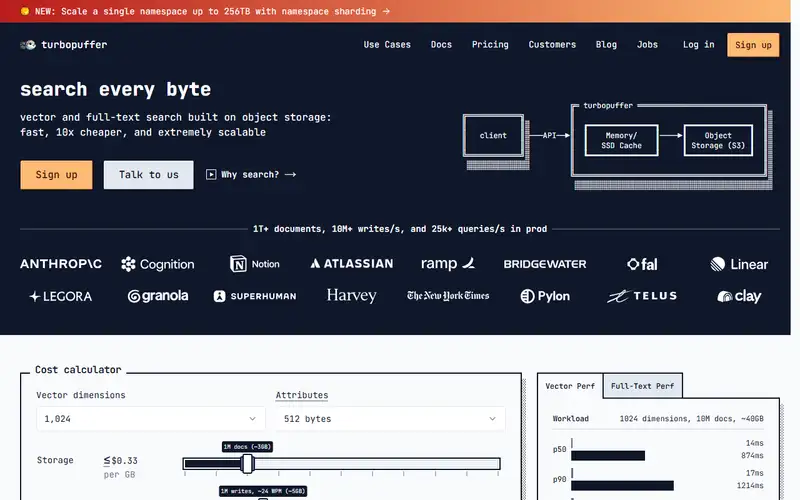
turbopuffer makes a specific architectural bet: search over object storage instead of keeping the index in memory. The stated consequences are that it can be about ten times cheaper than a memory-resident index and that a single namespace can scale to hundreds of terabytes, with memory and SSD serving as a cache in front of the object store rather than as the home of the data.
That trade changes which workloads fit. The usual reason a vector index is expensive is that all of it must be resident whether or not it is queried, which is painful if your corpus is large and access is uneven — a support archive, a document collection, an agent's long-term memory — and the object-storage approach prices the cold majority at storage rates. The trade-off is latency, and it is the number to test against your own access pattern rather than the one to take from a benchmark: the same design that makes a cheap cold corpus can be the wrong choice for a small index under constant load.
Sources
The factual claims in this review were read from the pages below. Each date is when an editor last opened the source, not when the product changed.
- Vendor site Checked 2026-09-19
Pros / Cons
Pros
- Prices a large, unevenly accessed corpus at storage rates instead of keeping all of it resident
- Full-text and vector search together rather than only embeddings
- Namespace sharding for very large single collections
Cons
- Latency is the trade and was not measured here, so it needs testing against your access pattern
- A small hot index may suit an in-memory store better
- The ten-times-cheaper claim is the vendor's and depends on what it is compared with
Who it's for
Search over a large corpus that is not queried uniformly
Long-term memory for agents
Cutting the cost of an oversized vector index
Full-text and vector search behind one API
Bottom line
A vector search engine that trades latency for storage-priced scale — check the latency against your own access pattern before the cost saving.
Key Features
Tags
Frequently asked questions
Is turbopuffer currently available?
No lifecycle review is recorded for this listing. Its inclusion in the directory does not confirm current availability; check the vendor before relying on it.
What is turbopuffer?
turbopuffer is a AI Platforms tool developed by turbopuffer. Vector and full-text search built on object storage rather than memory-resident indexes, priced as storage plus queries.
Is turbopuffer free?
turbopuffer uses pay-as-you-go pricing, so costs scale with how much you use it.
Is turbopuffer open source?
No — turbopuffer is proprietary software.
What are the best alternatives to turbopuffer?
Notable AI Platforms alternatives include Hugging Face, Replicate, Ollama. Browse all 138 tools in our AI Platforms category for a full overview.
Was this listing useful?
Basic Info
- Pricing
- Pay-as-you-go
- Editorial score
- ★ 4.3 / 5 How we score
- Platforms
- API
- Last verified
- Not recorded