
vLLM
Product status: Status not recorded
No lifecycle review is recorded for this listing. Its inclusion in the directory does not confirm current availability; check the vendor before relying on it.
No status check date recorded
An Apache-2.0 inference and serving engine with batching, hardware-specific backends and documented API interfaces; model and deployment compatibility need separate checks. No lifecycle review is recorded for this listing. Its inclusion in the directory does not confirm current availability; check the vendor before relying on it.
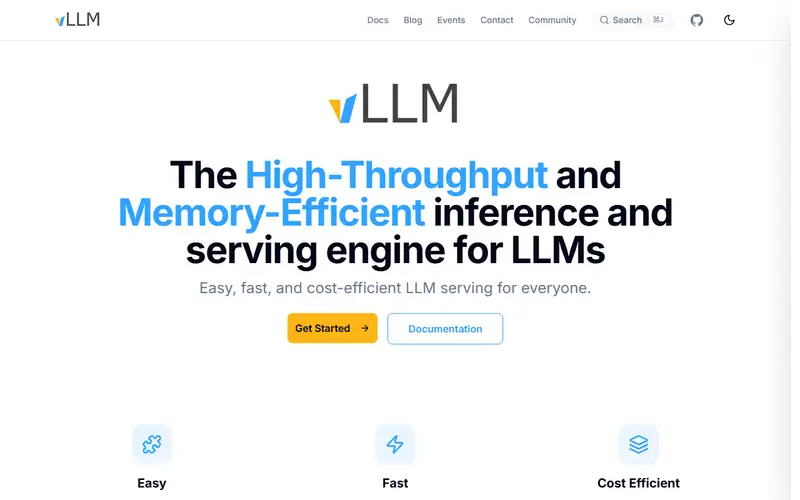
Product preview
Decision notes
Official-document research
Based on the cited documentation. We did not use the product, purchase a plan, or run quality, speed or reliability tests in this review.
Consider it for
- Engineers able to manage model-serving infrastructure
- Teams checking endpoint and hardware compatibility
Choose another approach if
- Expecting every OpenAI behavior without adaptation
- Assuming a free engine removes hardware or support costs
Pricing and conditions
Documented terms
Apache-2.0 engine code has no license charge. That is not free GPU/CPU capacity, electricity, storage, model access, engineering or a third-party endpoint. No hosted quote was verified; provider prices, currency, tax, regions, usage limits and support commitments require a separate deployment estimate.
Pricing source read:
Pricing or terms sourceCode, model and service licensing
Apache-2.0 covers engine code, including applicable notices, modification and patent conditions; it does not license every loaded model or your inputs/outputs. Review each weight/model and hosting agreement. Self-hosting control is not proof of confidentiality: network exposure, telemetry, logging, plugins and dependencies need configuration review. No blanket output ownership, no-training or zero-retention guarantee is established.
Basis and limits of the recorded score
The existing 4.8 is retained; its original scoring rubric is not recorded. This documentation review does not re-rate inference quality, performance or operating cost.
Overview
vLLM provides inference and an HTTP serving layer for supported models. Its documentation describes batching, PagedAttention and multiple hardware backends. Choose a supported model architecture, precision and hardware configuration before planning capacity; the project's throughput claims are not measurements of your model or traffic.
The OpenAI-compatible server supports specified endpoints under model-specific conditions. For example, chat needs a chat template, the completions suffix is unsupported and the user parameter is ignored. Integration still needs endpoint and behavior checks. You operate deployment, access control, scaling and maintenance, or contract separately with a hosting provider; this is not a bundled managed API.
Sources
The factual claims in this review were read from the pages below. Each date is when an editor last opened the source, not when the product changed.
- Vendor site Checked 2026-10-15
- Vendor documentation Checked 2026-10-15
- Vendor documentation Checked 2026-10-15
- Vendor documentation Checked 2026-10-15
Pros / Cons
Pros
- Documented API and model-serving controls
- Open engine code with configurable deployment
Cons
- API compatibility is conditional
- Capacity, access control and operations remain your responsibility
Who it's for
Evaluate a supported model behind a documented API
Plan a self-managed inference service for a defined workload
Bottom line
Select a supported model/hardware stack, then validate its API behavior and operating budget before production.
Key Features
Tags
Compare vLLM with alternatives
Frequently asked questions
Is vLLM currently available?
No lifecycle review is recorded for this listing. Its inclusion in the directory does not confirm current availability; check the vendor before relying on it.
What is vLLM?
vLLM is a AI Platforms tool developed by vLLM Project. An Apache-2.0 inference and serving engine with batching, hardware-specific backends and documented API interfaces; model and deployment compatibility need separate checks.
What costs and terms should I check for vLLM?
Apache-2.0 engine code has no license charge. That is not free GPU/CPU capacity, electricity, storage, model access, engineering or a third-party endpoint. No hosted quote was verified; provider prices, currency, tax, regions, usage limits and support commitments require a separate deployment estimate.
Is vLLM open source?
Apache-2.0 covers engine code, including applicable notices, modification and patent conditions; it does not license every loaded model or your inputs/outputs. Review each weight/model and hosting agreement. Self-hosting control is not proof of confidentiality: network exposure, telemetry, logging, plugins and dependencies need configuration review. No blanket output ownership, no-training or zero-retention guarantee is established.
What are the best alternatives to vLLM?
Notable AI Platforms alternatives include Hugging Face, Replicate, Ollama. Browse all 138 tools in our AI Platforms category for a full overview.
Was this listing useful?
Basic Info
- Pricing
- Free
Apache-2.0 engine code has no license charge. That is not free GPU/CPU capacity, electricity, storage, model access, engineering or a third-party endpoint. No hosted quote was verified; provider prices, currency, tax, regions, usage limits and support commitments require a separate deployment estimate.
- Editorial score
- ★ 4.8 / 5 How we score
- Platforms
- Self-hostedAPI
- Last verified
- 2026-09-08