
MinerU
Product status: Status not recorded
No lifecycle review is recorded for this listing. Its inclusion in the directory does not confirm current availability; check the vendor before relying on it.
No status check date recorded
Document parsing for AI: PDFs, Office files and images into structured Markdown, with layout, formula and table handling. No lifecycle review is recorded for this listing. Its inclusion in the directory does not confirm current availability; check the vendor before relying on it.
Product preview
Overview
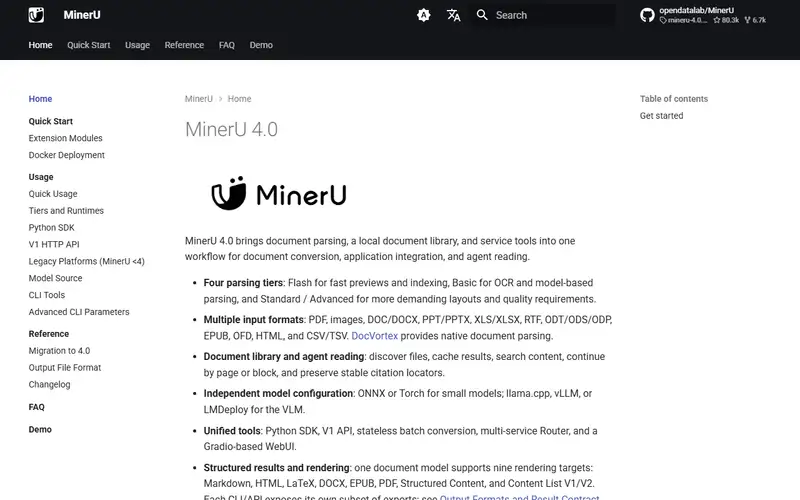
MinerU converts documents that were written for humans into something a model can read: PDFs, Office files and images in; structured Markdown with layout, reading order, formulas and tables preserved. It runs as a library, a CLI or a service, and it can be pointed at different backends — small models on ONNX or Torch, or a VLM served through llama.cpp, vLLM or LMDeploy. It also keeps page and block locators so a downstream agent can cite where a statement came from.
This is the unglamorous stage where retrieval quality is decided, and PDF is why. A PDF is a description of where ink goes, not what the text means: two-column papers, tables whose rows span pages, formulas as glyph soup, scanned pages with no text layer at all. Every chunking strategy downstream is built on whatever this stage decided, and a table split mid-row is not recoverable by any amount of tuning later — which is why parsing deserves the attention usually spent on the embedding model. The caveat is that quality is domain-specific: a pipeline tuned on academic papers meets an invoice or a scanned form and behaves differently, so the test is your own document types.
Sources
The factual claims in this review were read from the pages below. Each date is when an editor last opened the source, not when the product changed.
- Vendor documentation Checked 2026-09-19
- Vendor documentation Checked 2026-09-19
Pros / Cons
Pros
- Handles the document types where naive extraction quietly destroys meaning: multi-column, tables, formulas, scans
- Keeps locators, so downstream answers can cite where a claim came from
- Open source and runnable locally, with a choice of backends
Cons
- Parsing quality is domain-specific and was not tested on any document set here
- VLM backends bring GPU requirements that a small-model setup avoids
- The repository's licence is reported as non-standard, so terms should be read before commercial use
Who it's for
Building a RAG corpus from research papers or reports
Extracting tables from PDFs into structured data
Making scanned documents searchable
Giving an agent citable document context
Bottom line
Document parsing that decides retrieval quality before retrieval happens — test it on your own PDFs, since that is where the variance lives.
Key Features
Tags
Frequently asked questions
Is MinerU currently available?
No lifecycle review is recorded for this listing. Its inclusion in the directory does not confirm current availability; check the vendor before relying on it.
What is MinerU?
MinerU is a Agents & Developer Tooling tool developed by OpenDataLab. Document parsing for AI: PDFs, Office files and images into structured Markdown, with layout, formula and table handling.
Is MinerU free?
Yes — MinerU is free to use.
Is MinerU open source?
Yes — MinerU is open source. The source code is publicly available at https://github.com/opendatalab/MinerU.
What are the best alternatives to MinerU?
Notable Agents & Developer Tooling alternatives include Firecrawl, Browser Use, Daytona. Browse all 33 tools in our Agents & Developer Tooling category for a full overview.
Was this listing useful?
Basic Info
- Pricing
- Free
- Editorial score
- ★ 4.3 / 5 How we score
- Platforms
- LibraryCLIAPI
- Last verified
- Not recorded